

.png?width=3046&height=1536&name=Gemini_Generated_Image_rpwbmzrpwbmzrpwb%20(1).png)

The Challenge of Scaling
The growth of an EV charging network is rarely linear—it tends to occur in spikes. A marketing campaign, a fleet partnership, or a sudden regional expansion can take your network from 500 to 5,000 connected points in months.
The risk here is the "bottleneck effect." A Charging Station Management System (CSMS) that performs flawlessly with a few hundred chargers often collapses under the weight of thousands of simultaneous connections. Database locks, WebSocket limits, and API timeouts start to appear only when the system is under pressure.
To avoid this scenario, proactive validation is essential. You must prove that your infrastructure can handle the surge before it occurs. This means stress-testing the system to ensure it scales linearly. However, setting up these tests is traditionally a major drain on resources. It requires significant developer time to build the test tools, and if those tools are flawed, the resulting production errors can be incredibly expensive.
Historically, teams tried to solve this with custom scripts. But scripts have a fatal flaw: they usually just "DDoS" the server with simple pings. They check connectivity, but they don't respect the complexity of the OCPP protocol. They don't simulate a car plugging in, authorizing, and sending meter values. They generate noise, not reality.
Why Load Testing Matters
Integrating load testing provides distinct value for both leadership and engineering.
For the Business (Risk Mitigation)
- SLA Guarantees: Before bidding on large tenders, you can prove your platform can handle the requested volume (e.g., 10,000+ connectors).
- Preventing Reputational Loss: Nothing hurts a brand more than an app that hangs during peak hours, preventing drivers from charging.
- Budget Efficiency: Simulating 5,000 chargers costs a fraction of what it would take to buy, install, and connect physical hardware for a test lab.
For Technical Teams (Identifying Bottlenecks)
- WebSocket Stability: Verify if your load balancer correctly handles thousands of persistent connections.
- Database Throughput: Identify "slow queries" that only appear when writing thousands of MeterValues per second.
- Infrastructure Sizing: Stop guessing how much CPU/RAM you need. Run a test and size your AWS/Azure instances precisely.
What Is Load Testing on TimeTick?
TimeTick Load Testing turns the complex task of orchestration into a few clicks. It allows you to provision thousands of virtual chargers that behave exactly like real hardware.
This is not just "dumb traffic." It is a smart simulation. Every virtual charger created by TimeTick maintains a full WebSocket connection, respects OCPP 1.6 or 2.0.1 standards, responds to Heartbeats, sends MeterValues, and handles remote commands.
We use Realistic Behavior Profiles. Instead of just flooding the server, you can configure simulators to mimic specific scenarios—from simple connection maintenance to full charging cycles with status fluctuations. You aren't testing a server against a script; you are testing it against a simulated reality.
Real-World Scenarios
TimeTick’s configuration wizard is designed to address the specific challenges EV networks face.
1. The "Morning Spike" / Reconnection Storm
-
The Scenario: A regional power outage ends, and 5,000 chargers reboot simultaneously, all trying to send BootNotification at the exact same second.
-
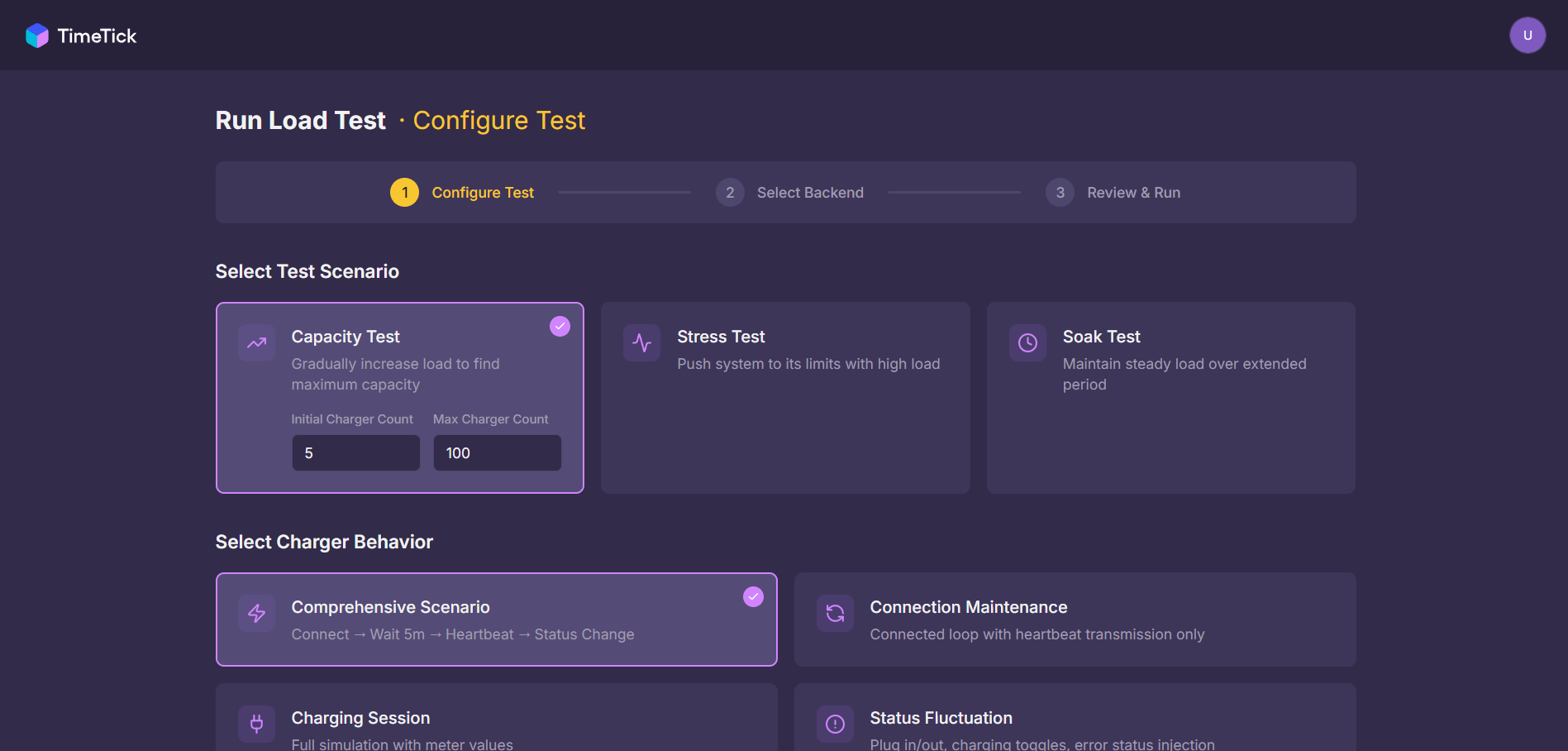
TimeTick Solution: Use Stress Test mode with a high "Maximum Charger Count" to test whether your backend can queue and process the load without crashing.
2. Peak Hours Simulation
-
The Scenario: It’s 6:00 PM on a Friday. Commuters are plugging in everywhere.
-
TimeTick Solution: Use the Capacity Test with a "Ramp-up" curve. Configure the behavior to "Charging Session" to flood the database with transaction start requests and meter data.
3. Long-term Stability (Soak Testing)
-
The Scenario: Memory leaks often don't appear within 5 minutes. They kill the server after 24 hours of operation.
-
TimeTick Solution: Use the Soak Test mode. Set a fixed count (e.g., 200 chargers) and run the test for 48 hours to monitor memory usage and resource degradation over time.
From Setup to Analysis
We designed the workflow to be intuitive, moving from configuration to insight in three steps.
-
Configuration
You don't write code; you select options. Choose your scenario (Capacity, Stress, or Soak) and define the behavior. Crucially, you can set Stop Conditions to protect your environment. For example, you can configure TimeTick to automatically abort the test if the backend Latency exceeds 1000ms or the error rate exceeds 1%. This ensures you don't waste time running a test that has already failed. -
Execution
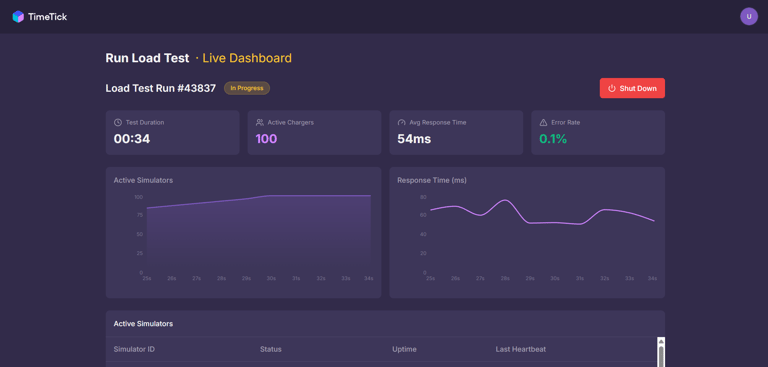
Once launched, you enter the Live Dashboard. This isn't a static log; it’s a real-time command center. You watch the "Active Chargers" ramp up on a sliding-window chart, monitor the average response time in milliseconds, and see a dynamic list of simulators sending heartbeats. You know instantly—not tomorrow—if the performance is degrading. -
Reporting
When the test finishes (or is stopped by your conditions), TimeTick generates a comprehensive PDF Report. This document summarizes the test settings, total duration, max charger count, and final error rates—perfect for attaching to release notes or sending to stakeholders.
About TimeTick
TimeTick is a comprehensive diagnostics platform for EV charging hardware and software. It allows you to run virtual chargers, connect real chargers to the TimeTick backend, validate backend logic, perform stress tests, and monitor device behavior in one environment.
TimeTick is a comprehensive diagnostics platform for EV charging hardware and software. It allows you to run virtual chargers, connect real chargers to the TimeTick backend, validate backend logic, perform stress tests, and monitor device behavior in one environment.
Managing EV infrastructure comes with plenty of challenges, from OCPP compliance to scaling issues. If diagnostics or testing are slowing you down, let’s figure it out together. You can schedule a TimeTick demo here to discuss your specific needs and see how we can help.
Author:

CEO and Founder
Palina Leibinskaya
Palina has been driving innovation in IoT technology for over 14 years and is currently the CEO and Co-Founder of TimeTick. Previously, she founded a leading software vendor specializing in high-load IoT solutions where she successfully led multiple deployments in the EVSE and fleet management sectors around the globe.
.png?width=2752&height=1536&name=Gemini_Generated_Image_fimlrkfimlrkfiml%20(1).png)