

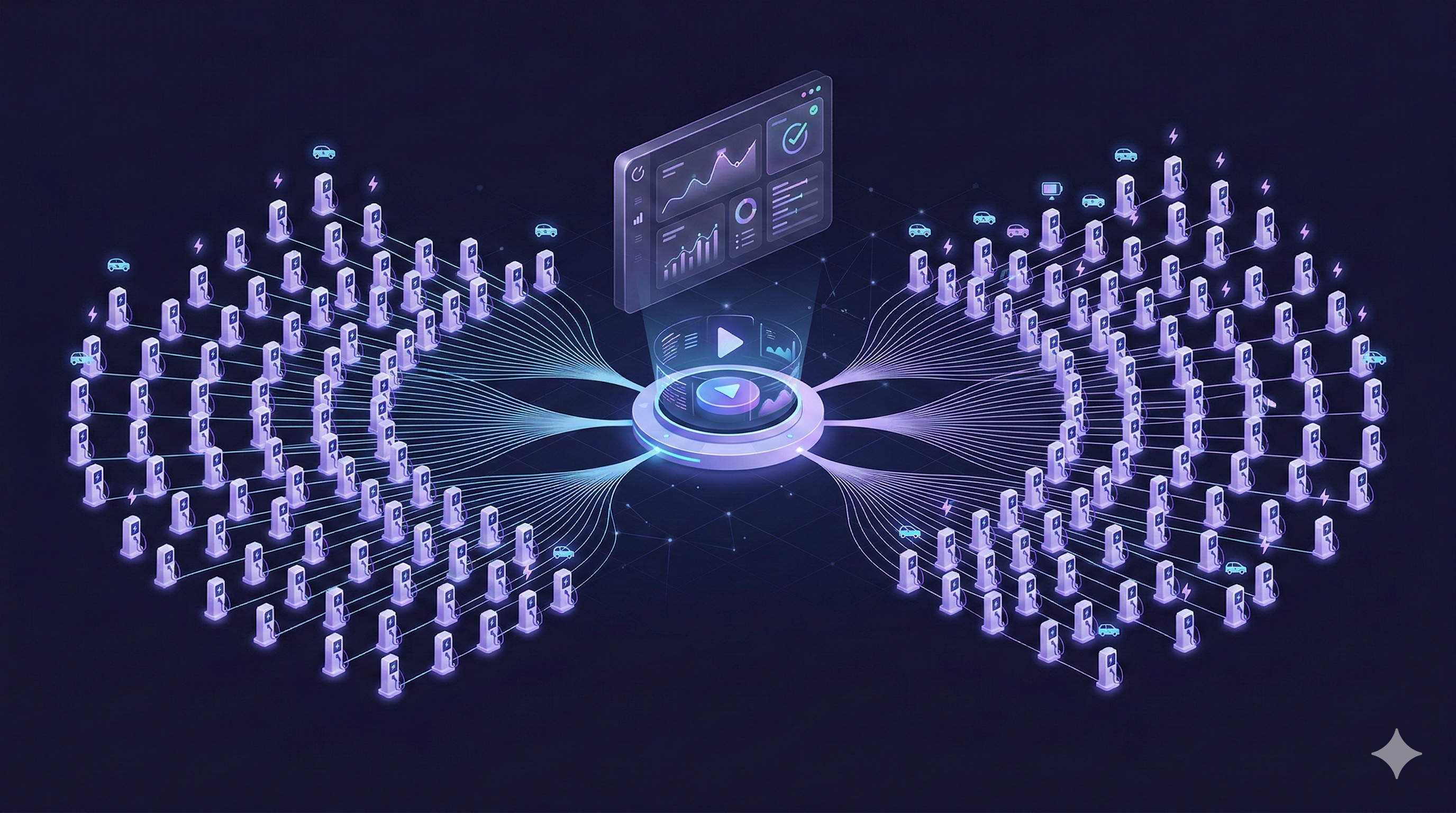

An EV charger simulator is a virtual device that behaves like a real charging station. It connects to a backend, uses the OCPP protocol, sends status updates, receives commands, and imitates the real charging process. A simulator allows you to reproduce the full lifecycle of a charging session without any physical hardware.
Why Simulators Matter
Simulators provide clear value for both business leaders and technical teams.
For the business
Simulators reduce costs, accelerate development, and shorten release cycles by removing the dependency on physical hardware and enabling faster, safer testing workflows.
For technical teams
Simulators improve software quality, catch errors early in development, and help teams validate complex scenarios long before they interact with physical chargers.
How EV Charger Simulators Are Used in Practice
Simulators help teams solve common challenges in the development, testing, and operation of EV charging infrastructure. They provide a safe, scalable, and hardware independent environment to validate charger behavior.
Key use cases:
- Continuous backend testing during development
Validate OCPP communication, command handling, and transaction flows from the earliest development stages without waiting for physical hardware or preparing a dedicated lab. - Load and performance validation
Launch hundreds or thousands of virtual chargers to understand how your backend behaves under realistic or extreme load and to identify bottlenecks before deployment. - Remote and distributed testing
Teams can work from anywhere. No lab setup, no equipment maintenance, and no dependency on physical chargers. - Pre commissioning and configuration checks
Integrators can validate configuration logic, backend settings, and custom workflows before real chargers arrive on site, reducing deployment time and errors. - Safe training and customer demos
Simulators allow product teams to demonstrate features, train support engineers, and replicate field scenarios without access to real hardware.
Typical Technical Scenarios
Companies use simulators daily to validate specific OCPP and backend behaviors such as:
- checking OCPP commands (Start, Stop, Remote Lock, Firmware Update)
- testing charging session and transaction logic
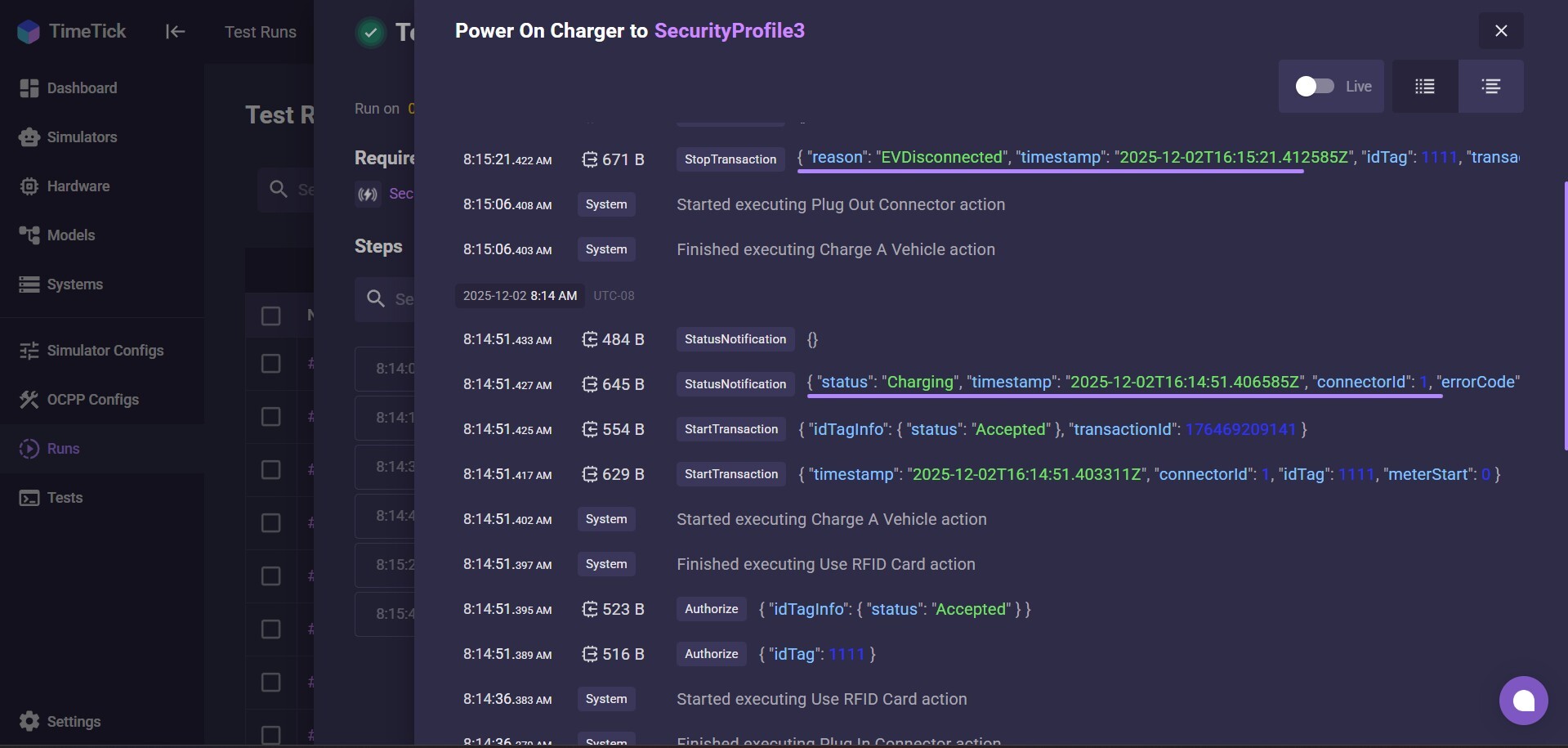
- simulating charger states like Available, Preparing, Charging, Suspended, Faulted
- reproducing rare errors and debugging backend logic
- performing large scale load and stress tests
- running automated QA suites with predictable device behavior
- verifying integrations with billing, monitoring, EMS platforms, and fleet systems
- safely testing firmware or backend changes before pushing updates to production
It is also increasingly common to include simulation directly into CI pipelines, where virtual chargers automatically spin up during each build to validate workflows and catch regressions early.
How To Use Simulators With TimeTick
With TimeTick you can simulate chargers on your backend in just a few minutes. Simply log in at app.timetick.io, choose the scenario “Simulate Chargers on Your Backend” on the dashboard, and follow the guided workflow.
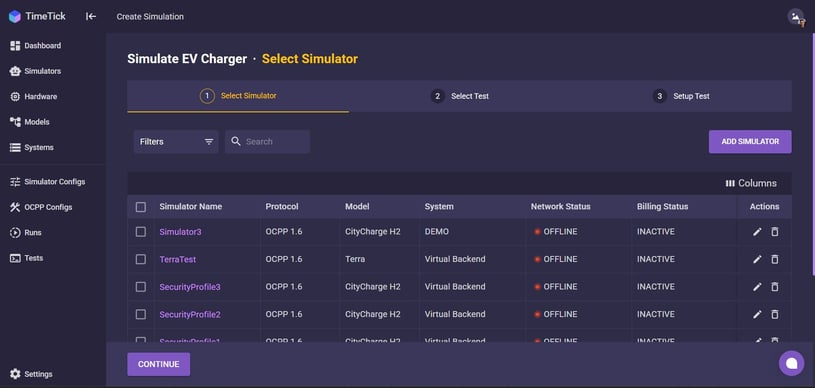
You can configure a simulator using built-in templates or create a custom configuration. Add your backend URL, choose the simulation mode, adjust parameters, and start the simulator. No advanced technical skills required.
TimeTick also includes built-in simulators for different charger manufacturers, replicating the behavior of their real devices.
You can scale testing from a single simulated charger to tens of thousands of devices and manage all sessions directly from the platform interface.
Additional capabilities inside TimeTick:
- real time message viewer for OCPP communication
- adjustable power levels, delays, and error states
- support for both AC and DC charger models
- quick cloning of simulators for large scale tests
- API access for CI pipelines, automation, or load generationability to connect real chargers to the TimeTick backend for hybrid testing setups
About TimeTick
TimeTick is a comprehensive diagnostics platform for EV charging hardware and software. It allows you to run virtual chargers, connect real chargers to the TimeTick backend, validate backend logic, perform stress tests, and monitor device behavior in one environment.
Author:

CEO and Founder
Palina Leibinskaya
Palina has been driving innovation in IoT technology for over 14 years and is currently the CEO and Co-Founder of TimeTick. Previously, she founded a leading software vendor specializing in high-load IoT solutions where she successfully led multiple deployments in the EVSE and fleet management sectors around the globe.
.png?width=3046&height=1536&name=Gemini_Generated_Image_rpwbmzrpwbmzrpwb%20(1).png)